Your First Two Weeks
The app hands you a dozen tools and trusts you to pick — which is lovely, unless you're brand new and have no idea what order they go in. Here's the order.
A quick promise before the plan: none of this is homework. There's no streak to protect and nothing resets if life gets in the way — the plan is a suggestion, not a contract. Ten minutes a day is plenty. Five counts.
Rule zero: tune, every time
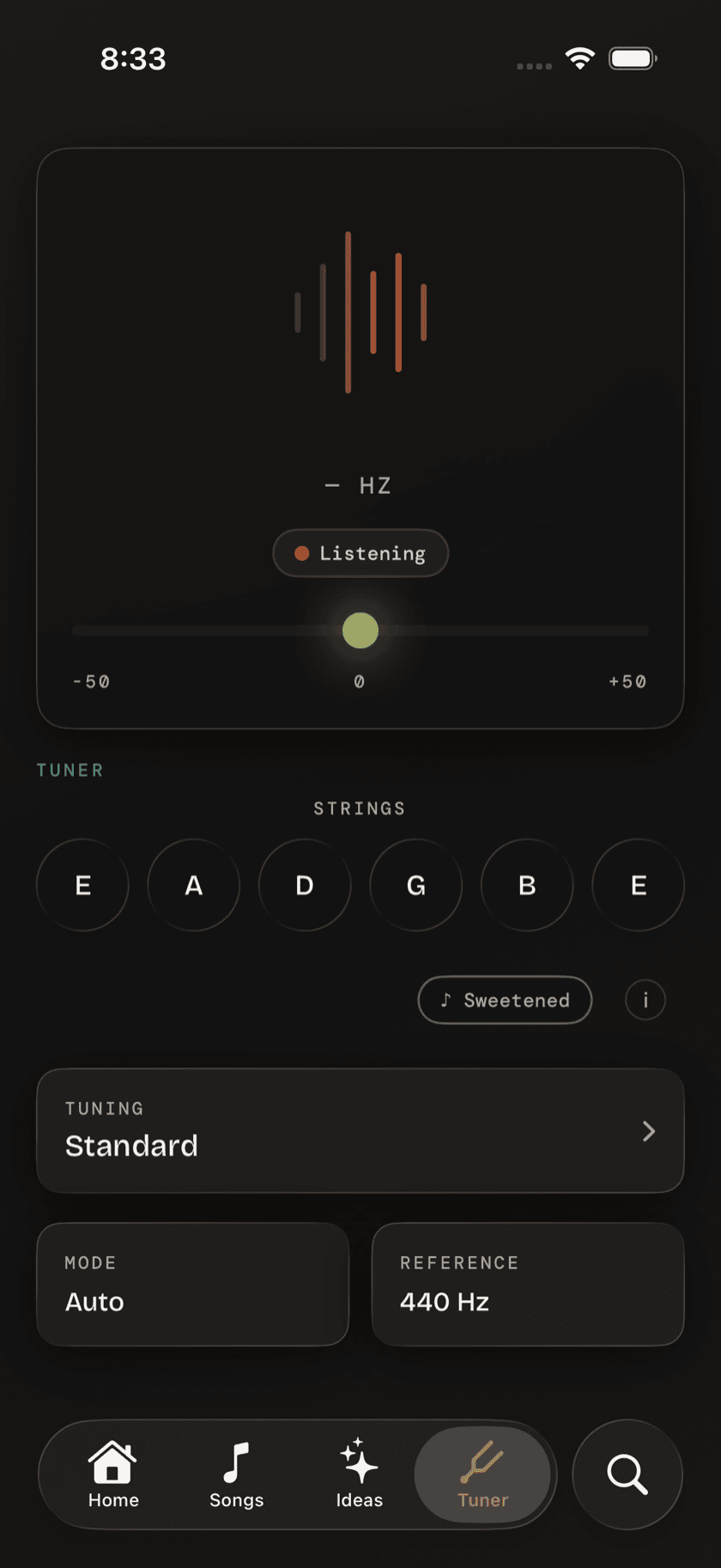
Every session starts the same way: open the Tuner tab and play each string open. The tuner listens and works out which string you're on by itself — no tapping through menus — and the meter goes solid green the moment you land. Thirty seconds, six strings, done.
This matters more than any other habit on this page. An out-of-tune guitar makes everything sound wrong, including the things you're playing correctly — and as a beginner you can't yet tell the difference between "I fretted that badly" and "this string is flat." Tuning first removes the doubt. If the room is noisy, or a second instrument keeps stealing the tuner's attention, tap a string letter to lock it onto that one note instead of guessing. The Tuner page covers the details, and the journal's tuning guide goes deeper on what EADGBE actually means.
Days 1–3: two chords
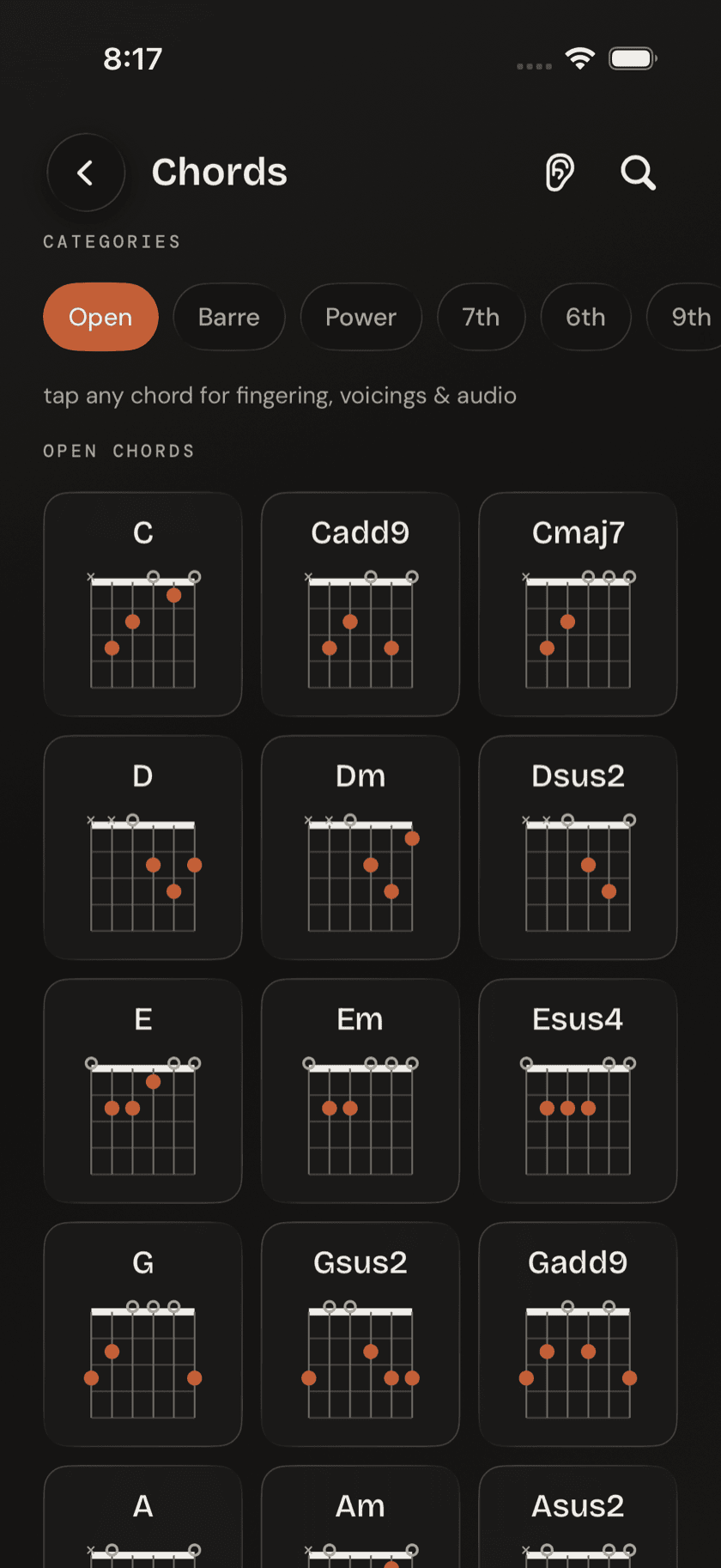
From Home, tap Practice tools, then Chords. Filter the grid to the Open category — that's where the friendly ones live. You want exactly two: Em and Am. Ignore the rest of the grid, however invitingly it sparkles, and give the Barre category a very wide berth for now.
Those two aren't a random pick. Em and Am are neighbors: the same pair of fingers, two frets up, nudged over one string — plus one extra finger for Am. Learning them together means your hand learns one move, not two unrelated ones.
Tap a chord to open it up: a full diagram, the notes that make it, and Strum, Arpeggio, and Slow buttons so you can hear what it's supposed to sound like before your hands know it. Play the app's version, then yours, and compare. Buzzing usually means you're touching a string you didn't mean to; a dead note usually means not enough pressure, or your finger sitting too far back from the fret.
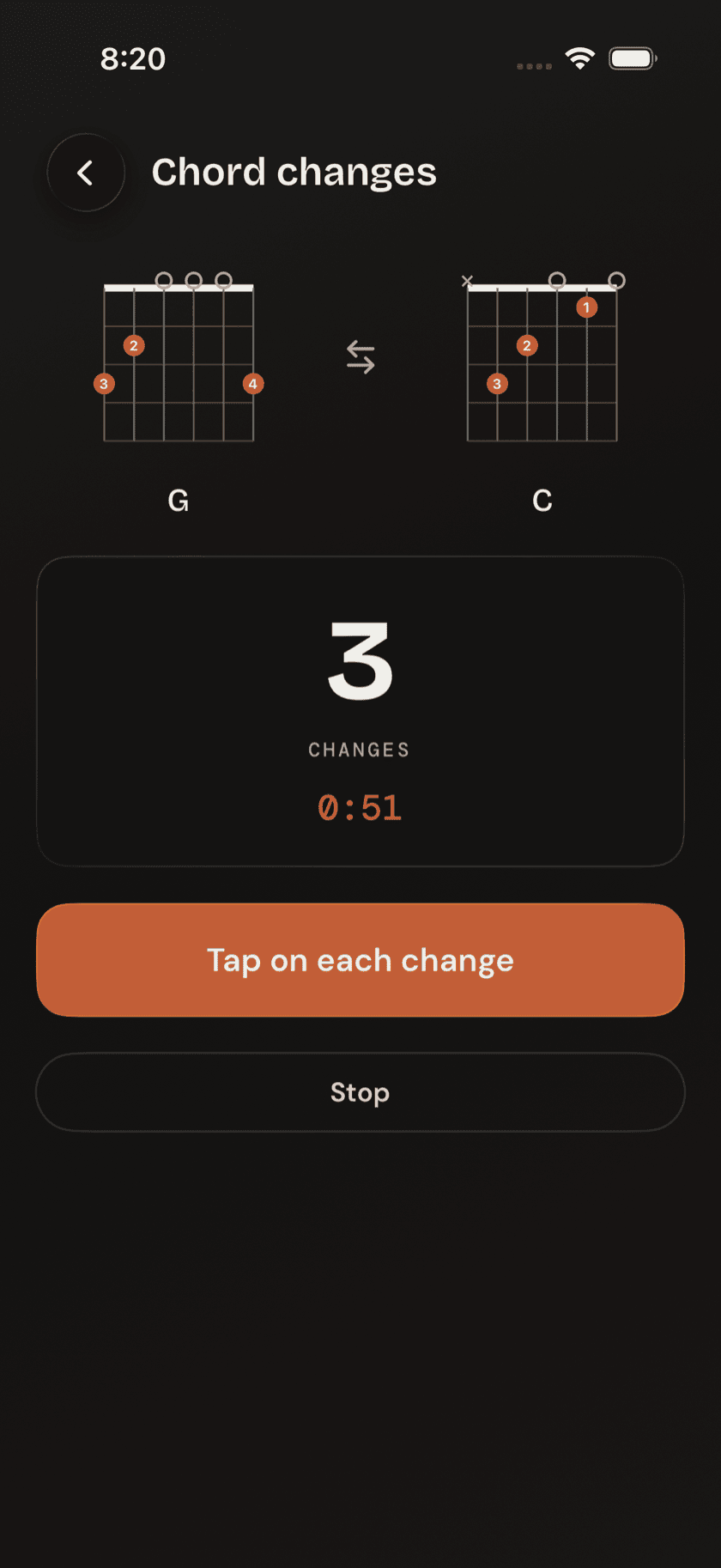
Then the real work, and it isn't learning more shapes: it's switching between the two you have. Em to Am, Am to Em, until it's boring. The switch is the skill — songs are just chord changes with a melody on top. When plain repetition wears thin, the Chord Change Trainer in Drills turns it into a game: set the two pickers to Em and Am, start the clock — 30, 60, or 90 seconds — and tap once for every clean change you land. It shows your last run on that same pair while you're there, and compares against nothing else; beating yourself tomorrow is the whole scoreboard.
If you'd like a second opinion on whether a shape is actually landing, Chord Coach listens through the mic while you strum and tells you if you're in the right neighborhood — root, and major or minor. It's a checkpoint, not a grade. And if chord diagrams themselves are still hieroglyphics, the journal's guide to practicing chords explains how to read one and how to press cleanly.
Days 4–7: one strum
Back in the practice hub, open Strumming. The pattern list runs easiest first; take the one at the top — Steady Downs. Four downstrums per bar. That's it, and that's enough.
Tap it and the player loops that one bar over a chord you pick from eight common shapes, with a count-in so you're never ambushed by bar one. Set it to Em, strum along until you stop thinking about it, then run it again on Am. When it feels solid, switch on Speed up gradually and the app raises the tempo over the course of the loop — you get faster without ever deciding to.
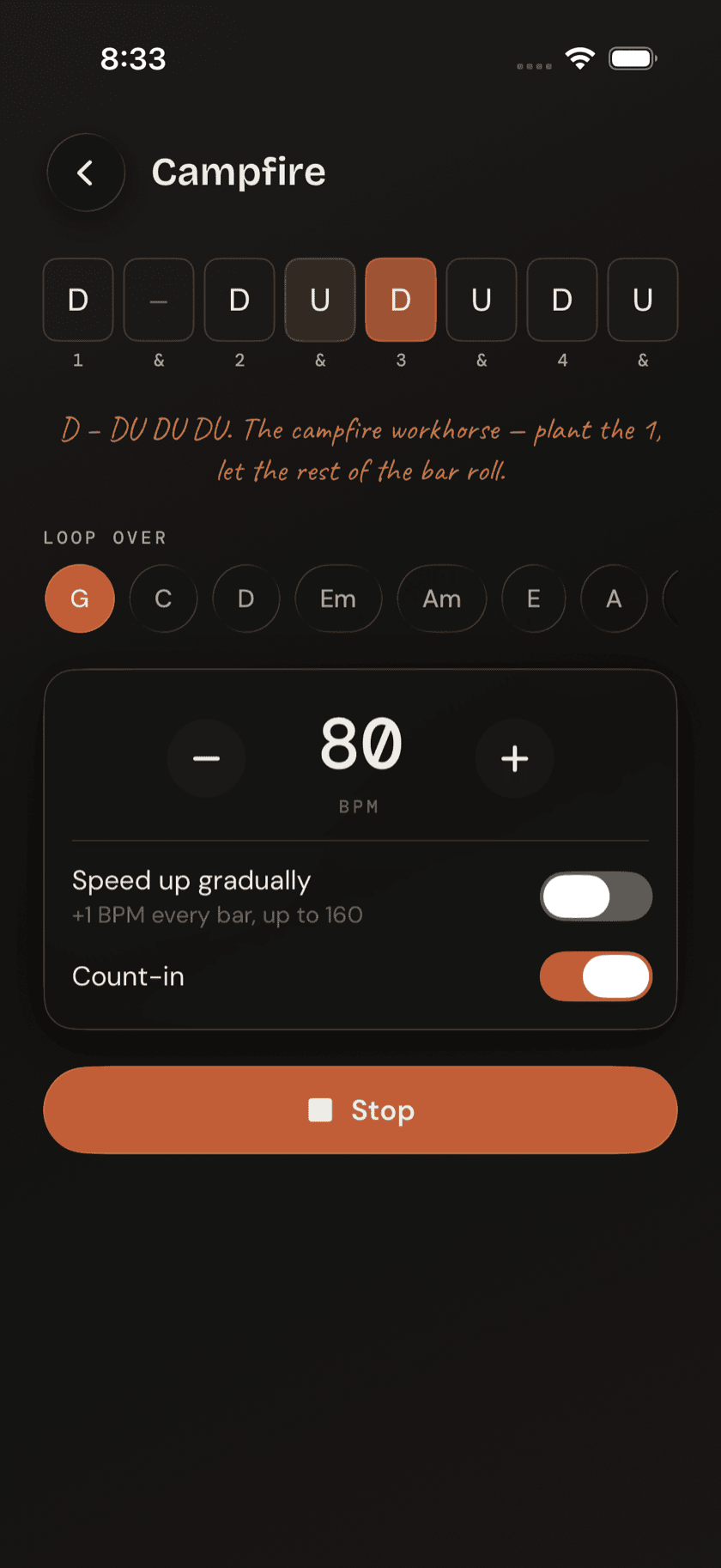
Once Steady Downs is dull, graduate to Campfire — down, down-up, down-up, down-up (D – DU DU DU). It'll feel lopsided for a day or two. That's normal; it's supposed to swing. The Strumming & Picking page covers the player in full.
By the end of the first week you have two chords, a strum, and — put together — the actual mechanics of playing a song. Em to Am with a rhythm on top is already music. So go and find some.
Week two: your first song
This is the part the whole first week was for. Two chords is a progression; three is a songbook — so start week two by adding C, and G a couple of days later. Same routine as before: look the shape up in the library, hear it, then drill the change from something you already know.
Then, on the Songs tab, tap + and choose Songs you can play. Tap the chords you know — Em, Am, C, whatever else has snuck in — and the app splits its catalog into two piles: songs whose every chord you already have, flagged ready to play, and songs sitting one or two new chords past your fingertips.
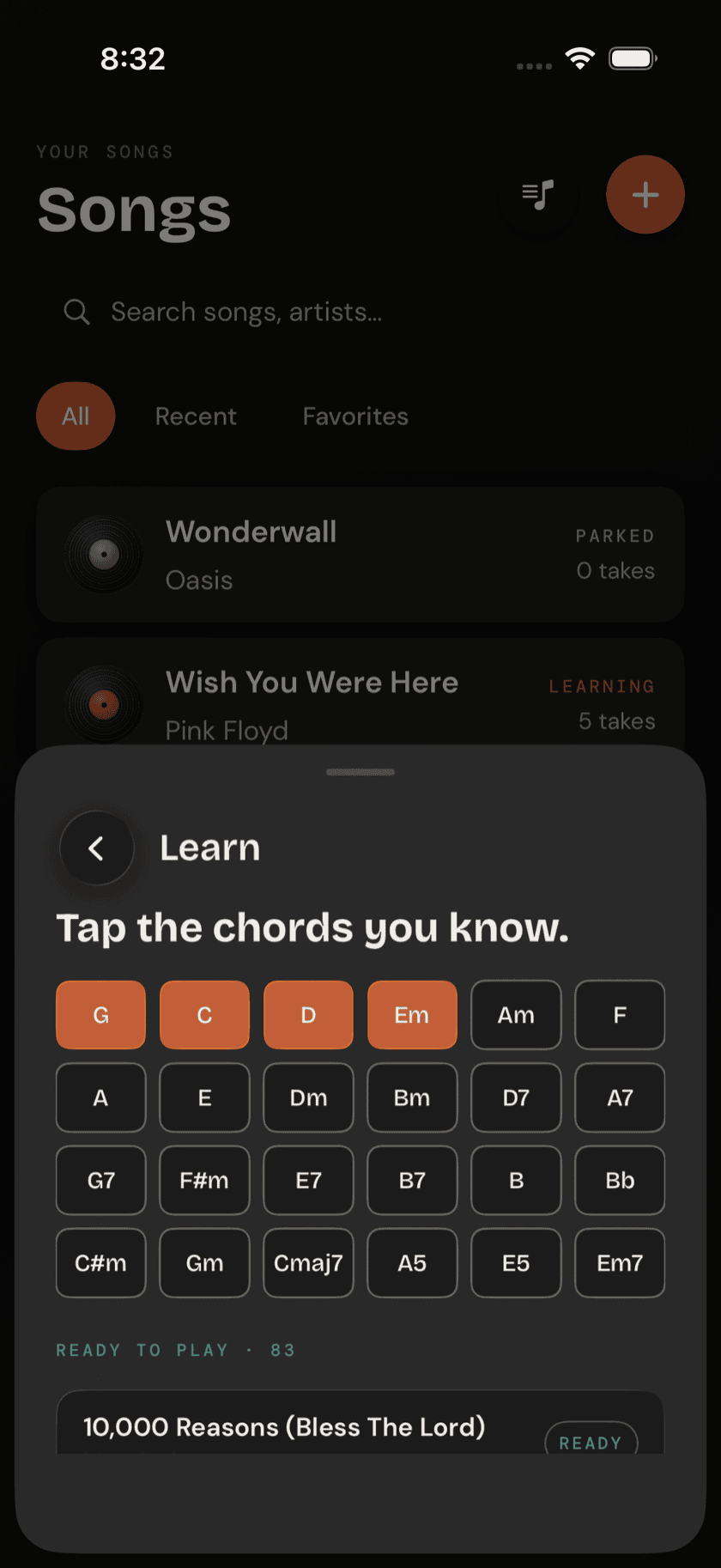
Pick something from the ready pile — ideally something you'd hum anyway; you'll practice a song you love ten times more than a song you're assigned. On the song's page, a chord grid runs across the top, and tapping any chord in it shows the fingering big and plays it, so you can check a shape without leaving the song. If a chord in there is beyond you, Simplify chords swaps the hard voicings for easier ones that sound near enough — and if a key change would turn friendly open chords into barre shapes, the app suggests a capo position instead of making your hands pay for it.
When you want the words too, bring in the full chord sheet: paste one in, or point the camera at a printed page and let the app read it. It opens with the chords sitting above the right lyrics, every one still tappable, and a teleprompter mode that scrolls hands-free while you play.
The two-pile screen is also your roadmap out of week two: it tells you exactly which chord to learn next. After C and G that's usually D, then F — and each new chord unlocks a visibly bigger slice of the catalog, which is the most honest motivation there is. The Songs page covers the library in full.
There's no penalty hiding anywhere in this. Skip a day, skip four — the app keeps no streak, sends no guilt, resets nothing. Two weeks of ten-minute sessions beats one heroic Saturday, but the app will never say so out loud.
What to ignore for now
The fastest way to stall in week one is opening everything. All of this is good, and none of it is for right now:
- Barre chords — they're a whole physical skill of their own, and nothing in your first fortnight needs one. F can wait, and a capo can cover for it in the meantime.
- Scales & Scale Coach — melody and improvisation tools. They matter the moment you want to play single notes; that moment is not week one.
- Fingerpicking — wonderful, and much easier once strumming is automatic.
- Fretboard Tools — the note trainer, the cheat sheet, the CAGED explorer. Learning the neck is a month-two project, not a day-two one.
- Loops & the Loop Trainer — for drilling a tricky passage in a specific song. You need a repertoire before you need surgery on it.
- Progressions, Jam, Metronome — the band can wait a week. The strum trainer's count-in keeps time for you until then.
Everything on that list will still be there in week three. That's the whole design.
When two weeks are up
If you've tuned, switched, strummed, and played something — you're no longer a day-one beginner, and the rest of the app starts making sense on its own. Three natural next steps, in rough order:
1. Make the plan a routine. The hub's Routines tool chains what you've been doing by hand — tune, chord changes, strum, song — into one guided, timed session you start with a single tap.
2. Meet the band. Progressions loops the chords you know with drums, bass, and keys behind you — the difference between practicing chords and playing music is mostly a rhythm section.
3. Just jam. When a progression feels good, Jam gives you the full band, your key, your tempo, and a record button.
And for the philosophy of what a single good session looks like — short, focused, ending on something fun — the journal's practice routine article is the companion piece to this page: this one told you which tools; that one explains how it stays a habit.