How to Build a Guitar Practice Routine That Lasts
Most routines fail not because players are lazy, but because the routine is designed for someone trying to win. Here's a quieter approach — one that actually sticks.
Here is what a typical guitar practice routine looks like, six weeks in: the apps haven't been opened, the streak is long since broken, the carefully blocked-out hour feels like a debt you keep meaning to repay. The guitar is in the corner. It's fine. You'll get to it.
This is not a failure of character. It's a failure of design.
The routines that most guitar method books and apps describe are built around discipline — the idea that consistency is something you enforce on yourself from the outside, with streaks and timers and goal graphs. That works, briefly, for some people. For most, it just makes the guitar feel like homework.
The moment practice becomes a game you can lose, you stop.
What actually keeps people playing for years isn't a rigid schedule. It's a relationship with the instrument — one that has room for bad sessions, short sessions, and sessions where you just noodle for twenty minutes and call it done. Here's how to build one.
Start with a single anchor, not a full schedule
The most durable guitar routines aren't structured around time — they're structured around a single consistent anchor. A moment in the day where picking up the guitar is the natural next thing to do.
For some people that's morning coffee. For others it's the twenty minutes between finishing dinner and whatever comes next. The anchor doesn't need to be long. It doesn't even need to happen every day. It just needs to exist: a slot where the guitar is the obvious thing to reach for, not a competing priority.
Before you plan what you'll practice, figure out when the guitar fits without a fight. That's your real routine.
The three-part session
Once you have an anchor, a loose structure helps — not because structure is sacred, but because it stops you from spending the whole session deciding what to do. Here's a simple one that works at any level:
1. Warm up (5–10 minutes)
Don't skip this. Cold hands make everything harder and increase the chance of strain. The warm-up doesn't need to be exercises — it can be as simple as playing through a chord progression slowly, or running a scale you already know. The goal is to arrive in your fingers, not your head.
2. Work on a song (most of your time)
Pick one song you're learning and sit with a section of it. Not the whole thing — a verse, a transition, a chord change that isn't landing. Slow it down until it's clean, then bring the tempo up gradually. Record yourself if you want to hear what it actually sounds like (it's usually better than you think, and occasionally worse in exactly the right ways).
The song is the point. Everything else — technique, theory, scales — makes most sense when it's in service of something you're trying to play.
3. Fundamentals (10–15 minutes)
A little goes a long way here. Spend a few minutes on whatever feels weakest: a chord transition, a picking pattern, a scale in a position you don't know yet. The key word is targeted — pick one thing, not a tour of everything you can't do.
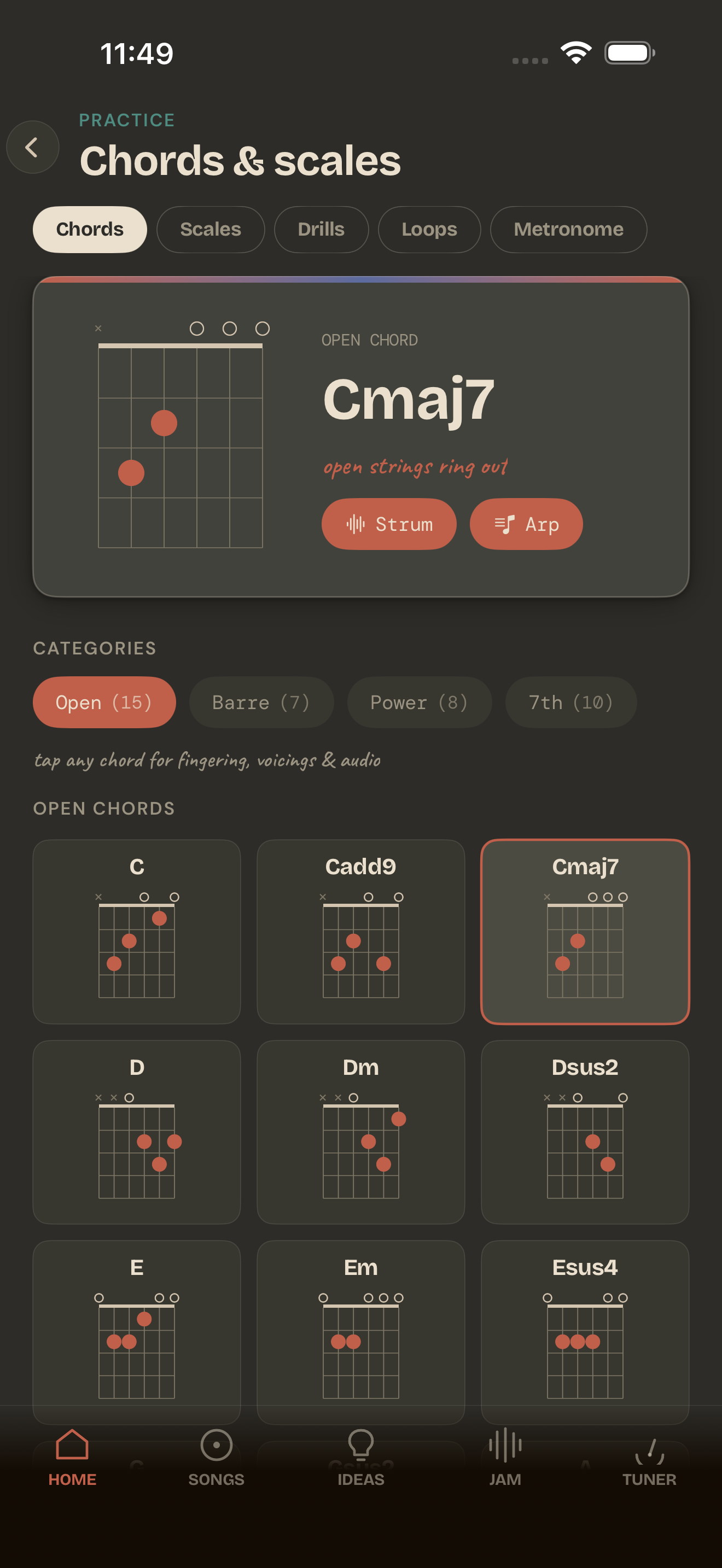
The Practice tab holds a shelf of chord diagrams, scale grids, and play-along drills — organized to dip into without ceremony. Your library remembers every song you've sat with, in order of when it last mattered.
What to do when you don't feel like it
This will happen. The routine you build needs to have an answer for it.
The answer isn't to force through a full session — it's to lower the threshold. Sit down and play one chord. Play through one verse. Tune up and put it back down. Maintaining the habit of picking up the guitar, even briefly, is more valuable than any individual session's content. The full sessions take care of themselves when the connection stays alive.
Some players find it useful to have a "minimum viable practice" — something so small it barely counts: five minutes, one song, one scale. If that's all they get in on a hard day, the streak is intact in the sense that actually matters. They sat with the guitar.
On keeping track
Progress on guitar is famously non-linear. You plateau for weeks, then something clicks. You nail a chord transition in one session after struggling for a month. Because of this, progress logs are useful primarily as evidence that you were here — not as a performance dashboard.
What's worth noting down, if anything: the songs you're working on, what's landing, what isn't. Not a grade, not a time log. A library. The kind of thing you might look back on in six months and find quietly encouraging.
The honest version of "how long should I practice?"
The common answer — "thirty minutes a day" — is a reasonable target that slightly misses the point. Consistency over duration is the real answer. Twenty minutes four times a week will get you further than two hours on a Sunday, every time.
Beyond that: practice until you're focused, not until a timer goes off. The moment you're noodling without attention is the moment to stop. That kind of mindless playing is fine — it's enjoyable, even — but it's not practice. Know the difference and you'll use your actual practice time better.
None of this is complicated. Complicated is part of the problem. The routines that work tend to be simple, forgiving, and organized around what you actually want to play — not around what you think you should be able to play yet.
Pick up the guitar. Stay with it a while. That's the whole routine.
A practice companion that stays out of your way.
No streaks, no goals, no account. Join the waitlist — we'll write once.