How to Learn a Song by Ear
Tab is a crutch. A useful one — but learning to find notes yourself is one of the most satisfying things a guitarist can do. Here's where to start.
For most guitarists, learning a new song looks like this: search for the tab, load it up, start on bar one, try to keep up with the tempo markers, get stuck at the tricky part, look for a YouTube walkthrough. This works. It gets you to a playable version of the song, and there's nothing wrong with it.
But something is missing from that process — the part where your ear and your hands learn to talk to each other. The part where you start to understand not just what is being played, but why it sounds the way it does.
Learning by ear is the older method. It's how most great guitarists — before the internet, before even widely available printed music — learned everything they knew. It develops a kind of musical literacy that tab can't give you, and it makes every song you learn feel more genuinely yours.
When you learn a song by ear, you're not copying. You're translating.
Start with something you know extremely well
The first mistake most players make is trying to learn by ear something they barely know by heart. If you have to concentrate on remembering the melody while simultaneously trying to find it on the fretboard, you're doing two hard things at once.
Start with a song you've listened to so many times you can hear it clearly in your head with no playback. A childhood favourite, a song you've sung along to for years, something you could hum right now without thinking. The more fluent you are with the music in your mind, the easier it is to chase it down on the guitar.
Slow it down — without changing the pitch
The most powerful tool for learning by ear isn't your ear. It's your tempo control.
Most music is recorded at a speed that makes individual notes and transitions hard to catch in real time. Slow the track to 60–70% speed — without pitch-shifting it down — and suddenly you can hear the attack of each note, the exact moment a chord changes, the pick direction in a riff. Details that were blurred together at full tempo become distinct.
Your phone's music app probably has this feature. Most guitar learning apps do. Use it. Play a section at half speed until you can follow it note by note, then bring the tempo back up gradually.
Isolate the smallest useful piece
Don't start with the whole song, or even the whole verse. Start with the smallest section that sounds complete — a riff, a two-bar phrase, the opening four notes of the melody. Loop it. Play it ten times. Find the first note before you think about the second.
This sounds obvious, but most players skip it. They try to track the whole musical line at once, get confused in the middle, restart from the beginning, and make the same mistake in the same place. Isolating forces patience in a way that's deeply useful.
Finding the root note
The first practical step: find where the phrase lands. Most musical phrases resolve to a "home" note — the tonic of whatever key the song is in. That note will feel stable and restful when you hit it. Once you've found it on the fretboard, you have a reference point for everything else.
Moving by intervals
From the root, the next notes are usually a predictable distance away. A step up or down the scale. A jump of a fifth. Interval training — recognising the characteristic sound of different distances between notes — is what allows experienced players to transcribe quickly. You don't need formal theory for this. You need to listen, a lot, and make the connection between what you're hearing and what your hands are doing.
Recognise chord sounds, not just chord names
For rhythm playing, you're not chasing individual notes — you're chasing chord qualities. A major chord sounds bright and resolved. A minor chord sounds darker, more interior. A dominant seventh chord sounds tense, like it wants to move somewhere.
Training yourself to hear chord quality — even before you know the specific chord — narrows the search dramatically. If the verse of the song sounds minor, you're already ruling out most of the major chords. If a chord sounds tense and unresolved, you're probably looking for a seventh or a suspended chord.
This kind of recognition comes with time and listening — but it comes faster if you practice it deliberately. When you learn a song, note the quality of each chord, not just its name. Over time, the sound-to-shape connection becomes automatic.
Use the recording as the answer key
When you think you've found something, check it against the recording. Play along — or try to. If it fits, you've got it. If something feels slightly off, don't guess: go back to the loop, slow it down, and listen again.
The recording is always right. Your tab, your YouTube tutorial, even your teacher's version might have small errors. The recording doesn't.
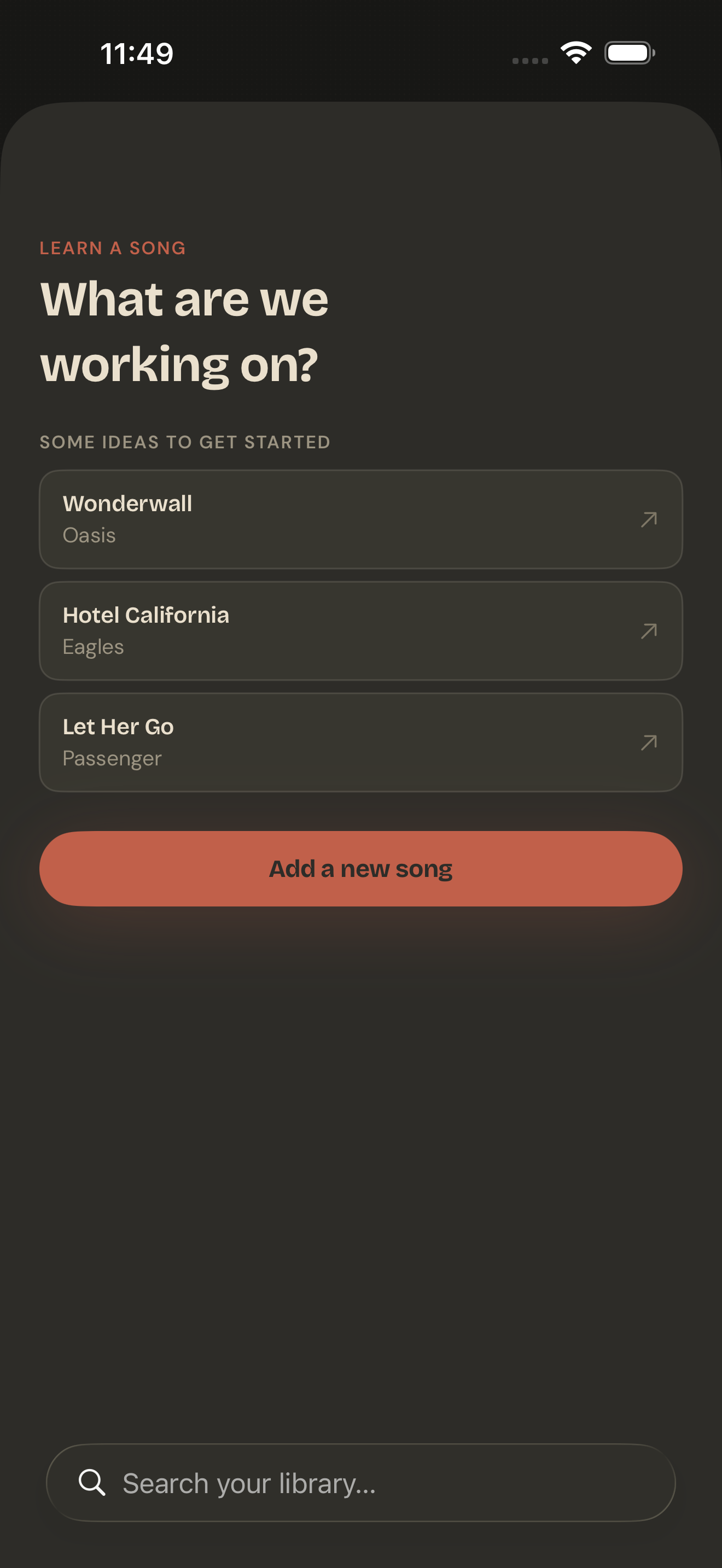
The Learn feature pulls chord charts for any song you're working on, gives you a place to record your working takes, and keeps your whole library in order of what you've played most recently. Not a replacement for ear training — a companion to it.
What to do when you're stuck
You will get stuck. A note that should be obvious isn't. A transition happens too fast to catch even at half speed. The chord quality is ambiguous.
When this happens, the most useful moves (in order) are:
- Slow down further. 50%, then 40%. It often becomes audible.
- Sing it. Vocalize the phrase before you look for it on the guitar. If you can sing it accurately, your hands can find it — the connection between voice and instrument is surprisingly direct.
- Check your tuning. An out-of-tune guitar makes everything harder to match.
- Try a different position. The same note exists in multiple places on the fretboard. If you're searching in one area and it's not resolving, try another octave.
- Look at the tab — just for that phrase. This isn't failure. Sometimes seeing the position confirms what your ear was already telling you, and the next section comes easier.
The long game
Learning by ear is a skill that builds slowly and then suddenly feels effortless. The first song you work out this way might take an afternoon. A few months in, you'll find yourself playing along to something new within a few minutes, making small corrections as you go, no tab required.
That transition — from following instructions to actually hearing music — is one of the most meaningful shifts a guitarist makes. It happens gradually, and then it doesn't feel like a shift at all. It just feels like playing.
Learn the songs you love.
Pull any song, see the chords, record yourself working it out. No streaks, no account — just the music.