How to Practice Guitar Chords Without Getting Frustrated
Chord changes feel impossible at first — fingers that won't cooperate, buzzing strings, transitions that collapse under any tempo. Here's a method that actually works, and why most chord practice doesn't.
Every guitarist remembers the chord wall. The moment when you've learned a handful of shapes in isolation — they ring cleanly when you hold them still — and then you try to move between them in time with a song, and everything falls apart. The fingers arrive late. The chord buzzes. The rhythm lurches. You wonder if your hands are simply wrong for this.
They aren't. Chord transitions are genuinely hard, and the reason most practice doesn't fix them is that most practice doesn't target the actual problem.
What you're actually trying to build
A chord change has three components that all need to work together:
- Shape memory — your fingers know where to go without looking
- Transition speed — the movement happens fast enough that the gap is inaudible
- Arrival quality — the chord lands cleanly, with all strings ringing and no buzzing
Most beginners practice by strumming through a chord progression at whatever tempo the song demands, stopping when something goes wrong, and starting again. This trains shape memory in a limited way, but it doesn't target transition speed or arrival quality directly. You're practicing the whole song, which means you're practicing the transitions briefly, at speed, and with the added pressure of keeping up. That's the hardest possible context to improve in.
You don't get faster by playing fast. You get faster by playing slow enough that you're always succeeding.
The one-minute change drill
This is the most effective chord transition exercise there is. It requires a timer and nothing else.
- Pick two chords — just two, the ones giving you the most trouble.
- Set a timer for one minute.
- Do nothing but move between those two chords for that minute. Back and forth, back and forth, as many times as you can while keeping both chords clean.
- Count the transitions. Write the number down.
- Do it again tomorrow. Try to beat the number.
The counting matters. It gives you a concrete target, keeps you focused for the full minute, and — more importantly — shows you that you're improving. Chord transitions get better slowly and invisibly until you have a number. With a number, the progress is undeniable.
One minute per pair, per practice session. If you have three troublesome pairs, that's three minutes. It's one of the highest-return things you can do with a small amount of time.
Anchor fingers: the shortcut most players miss
Between many chord pairs, there's at least one finger that doesn't move — or barely moves. Finding and using that finger as an anchor dramatically reduces the cognitive load of the transition, because you're moving fewer fingers independently.
The classic example is the move between C major and A minor: the first and second fingers stay in almost exactly the same position. If you lift all four fingers completely off the fretboard and replace them, you're doing four separate placement tasks. If you leave your anchor fingers touching the strings and slide them slightly, you're doing one.
For any chord pair you're practicing, ask: which fingers don't have to move? Keep those fingers as close to the strings as possible — touching the wood, if not pressing down — while the others find their new positions. The anchor is your hinge point.
Common anchor finger pairs worth knowing
- G → Cadd9 — keep the third and fourth fingers planted on the first two strings. One of the most useful anchors on the guitar.
- C → Am — first and second fingers barely move. The third finger lifts, the ring finger plants on the B string.
- D → A — the first finger can stay close; the shape rotates around it.
- Em → Am — the entire shape shifts one string set toward the floor. Think of it as moving the pair together.
Clean before fast
A buzzing chord is not a chord. It's two or three notes and some percussive thud. When you practice at a tempo that produces buzzing, you're reinforcing the muscle memory of arriving sloppily — and muscle memory is stubborn.
Slow down until every note rings. This might mean a tempo that feels laughably slow. It might mean the gap between chords is a full beat. That's fine. The goal at this stage is to engrave the sensation of a clean arrival so that your hands know what success feels like.
A metronome is useful here — not to push the tempo up, but to hold it steady. Pick a tempo where you can execute the change cleanly nine times out of ten, and stay there until it's ten out of ten. Then move the tempo up by a small increment. This is the only reliable way to add speed without adding slop.
The buzzing string problem
If a string is buzzing, it's almost always one of three things:
- The fretting finger isn't close enough to the fret. Move your finger forward — toward the soundhole — until it's just behind the fret wire. You should need less pressure and get less buzz.
- An adjacent finger is accidentally touching the string. Check each finger's angle. Fingers should be as upright as possible, touching only their own string.
- The chord shape is slightly off. Look at where your thumb is sitting on the back of the neck. Too far back and the fingers flatten; too far around and they cramp. The thumb position changes everything about how clean your fretting hand can be.
Fix the buzzing before you practice the transition. Practicing a slightly wrong chord shape drills the wrong shape.
How many chords to practice at once
Most chord practice spreads attention too thin. Running through a twelve-chord song and calling it chord practice means each transition got about four seconds of focused attention. That's not enough to move the needle on any of them.
Pick the single hardest transition in whatever you're working on. Drill that pair with the one-minute exercise until it's clean and starting to feel automatic. Then move to the next hardest. This is slower in the short term and dramatically faster over a month.
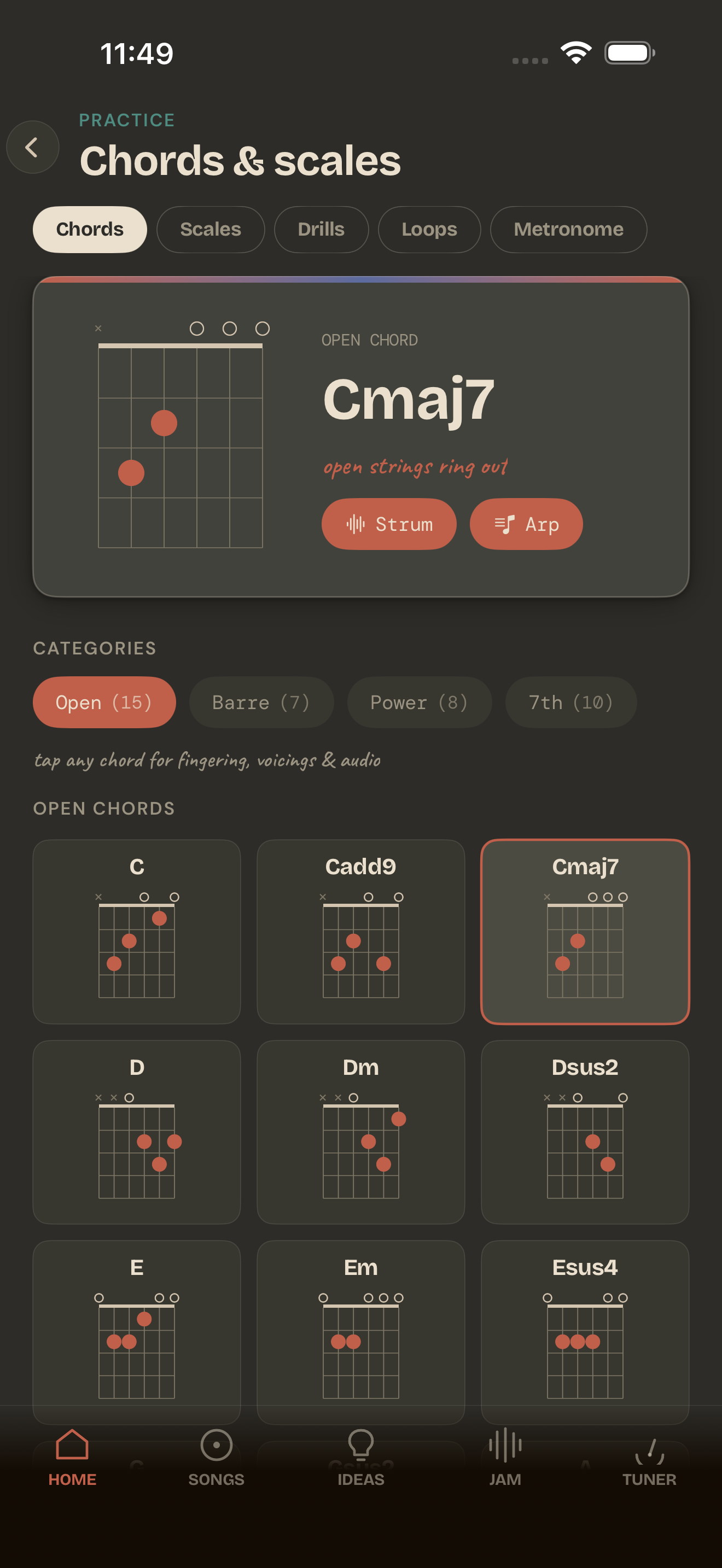
The Practice tab includes chord diagrams for every common shape — open, barre, and extended — organized by root note and quality. When you're working on a song, the chord shelf surfaces the shapes that appear in it. No searching.
When to stop
Chord practice benefits from short, focused sessions more than long frustrated ones. Twenty minutes of genuinely attentive drilling — counting transitions, noticing buzzes, fixing them — does more than an hour of going through the motions while watching something else.
And when you hit the wall — when the transition keeps failing and you can feel yourself tensing up — stop. Not for the day necessarily, but for that pair. Tension in the hands and frustration in the mind are the enemies of motor learning. Play something you already know, let the hands settle, come back to the hard thing later or tomorrow.
The progress will be there. It almost always shows up between sessions, not during them — a mysterious quality of motor learning that every guitarist eventually notices and learns to trust.
Chord diagrams for every shape you need.
Open, barre, and extended chords — surfaced for whatever song you're working on. Free from day one.