How to Tune a Guitar: Standard, Drop & Open Tunings
Tuning is the first thing you do and the last thing you think about. A guide to getting it right — and to the beautiful weirdness of alternate tunings.
An out-of-tune guitar is the single most discouraging thing a beginner encounters and the single thing most experienced players are least patient about. Nothing you play sounds right. Chords that should ring beautifully sound sour. You start to wonder if the problem is you.
It isn't. It's the tuning.
Tuning a guitar takes about ninety seconds once you know what you're doing, and it changes everything. Here's how to do it properly — standard tuning first, then the alternate tunings worth knowing.
Standard tuning: EADGBe
Standard tuning is the same six notes that virtually every guitar method, tab, and chord diagram assumes you're using. From the thickest string (nearest the ceiling when you're playing) to the thinnest:
| String | Note | Memory hook |
|---|---|---|
| 6th (thickest) | E | Elephants |
| 5th | A | And |
| 4th | D | Donkeys |
| 3rd | G | Go |
| 2nd | B | Barking |
| 1st (thinnest) | e | Everywhere |
Use a chromatic tuner — a clip-on, a phone app, or a pedal — and tune each string until the needle (or equivalent indicator) is centred and steady. Tune up to pitch rather than down to it: if you overshoot, detune past the note and approach from below. Strings stretch, and a string tuned from above will slip flat quickly.
Acoustic strings move more air, so they sustain longer and are easier to read on a tuner. Electric strings are quieter at low volume — if you're having trouble getting a good read, plug in, or use a clip-on tuner that reads vibration directly from the headstock rather than via microphone.
Why your guitar might never tune perfectly
Here's something that bothers guitarists more than it should: a perfectly tuned guitar — every open string hitting its target precisely — will still sound slightly off in certain chord shapes. This is not a defect. It's physics.
The guitar fretboard is built on equal temperament, a tuning system that spreads the "wrongness" evenly across all twelve keys so that no single key sounds terrible. The trade-off is that no key sounds perfectly in tune either. Other fixed-pitch instruments have the same compromise. This is why a piano and a guitar, both in tune, can sound slightly argumentative together.
Practically speaking: tune to a chromatic tuner, adjust by ear if one chord sounds noticeably off, and don't chase perfection. A guitar that's close is a guitar you can play.
Sweetened tuning
Some players — particularly fingerstyle and solo guitar players — use sweetened tuning: tiny deliberate deviations from equal temperament that make common open chord shapes ring more purely. The amounts are small (a few cents on certain strings) but the effect is audible, particularly on a well-resonating acoustic.
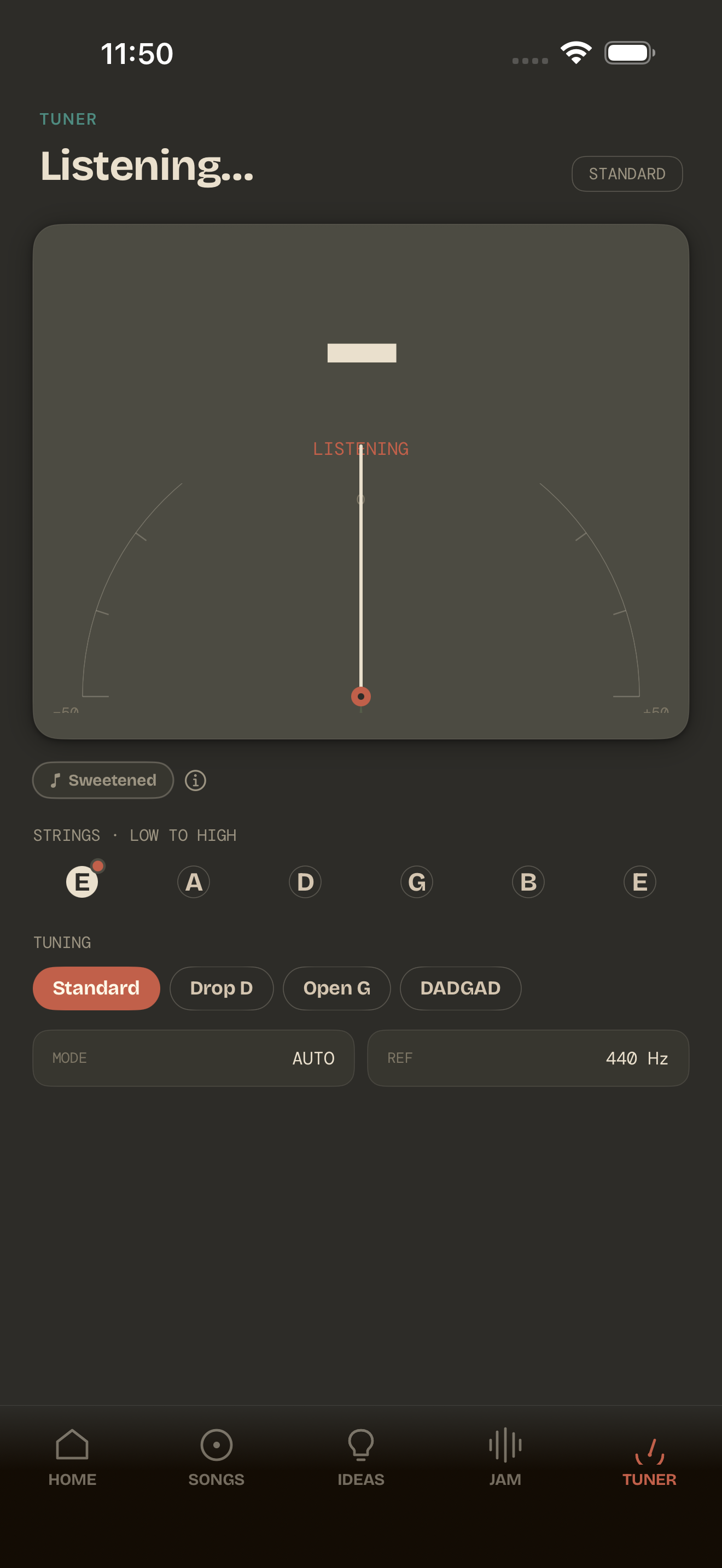
Guitar Buddha's tuner includes a sweetened mode for players who want it. It's not for everyone — if you play with other instruments or to backing tracks, equal temperament is the better call. But for solo playing, it's worth trying.
Alternate tunings worth knowing
Standard tuning is the right starting point, but it isn't the only one. A handful of alternate tunings unlock sounds and chord shapes that are awkward or impossible in standard — and some of the most memorable guitar parts in recorded music are built on them.
Drop D (DADGBe)
The most practical alternate tuning. Lower just the 6th string from E down to D. This gives you a droning low D bass note and — most importantly — lets you play power chords on the bottom three strings with a single finger instead of two. Rock and metal players use it constantly. Getting in and out of it mid-set is fast enough to do between songs.
Open G (DGDGBd)
Strum all six strings open and you get a G major chord. Keith Richards famously removed the 6th string entirely when playing in open G; it frees the thumb and changes the whole feel of the instrument. Slide guitar lives here. Blues, folk, and country players reach for it often.
Open D (DADf#Ad)
Same idea as open G, but resolves to D major. A favourite for slide and for the resonant, slightly melancholy sound of a lot of acoustic folk and blues. Joni Mitchell used it throughout her most celebrated work.
DADGAD
Not a major or minor chord — it's a suspended chord, which gives it an open, undecided quality that works beautifully for Celtic and fingerstyle music. Jimmy Page used it on Kashmir; Pierre Bensusan built a career on it. It takes some relearning but rewards patience.
The Tuner supports standard tuning, all common drop and open tunings, and custom tunings you define yourself. Sweetened mode is a single tap away. When you add a song that uses a specific tuning, the app surfaces it automatically.
How often should you tune?
Every time you sit down to play. Strings go out of tune — with temperature changes, humidity, string stretch, and just the passage of time. New strings go out of tune aggressively for the first day or two until they've stretched and settled. The habit of tuning before you play is worth building early; it's fast, and it means every session starts with a guitar that sounds the way it should.
One last thing: tune before you warm up, not after. Playing cold strings stretches them slightly, so if you tune up and then do ten minutes of open-chord strumming, you'll want to check again before you get into anything careful.
A tuner with a soft touch.
Standard, drop, open, and custom tunings. Sweetened mode for players who want it. Everything free from day one.