Fretboard Tools
Three tools built around one idea — knowing where every note actually lives on the neck, separate from any single chord shape or scale pattern.
Every chord and scale you've learned so far is really just a shape — a pattern you can slide around without necessarily knowing what's underneath it. The Fretboard tools are where you learn what's underneath: every note, on every string, and how the shapes you already know connect to each other once you take the training wheels off. They live in their own Fretboard card on the Practice Hub, apart from the chord and scale libraries, because this isn't a lookup job — it's a drilling one.
There are three ways in: quiz yourself, keep a reference handy, or see how movable shapes fit together.
Fretboard Trainer
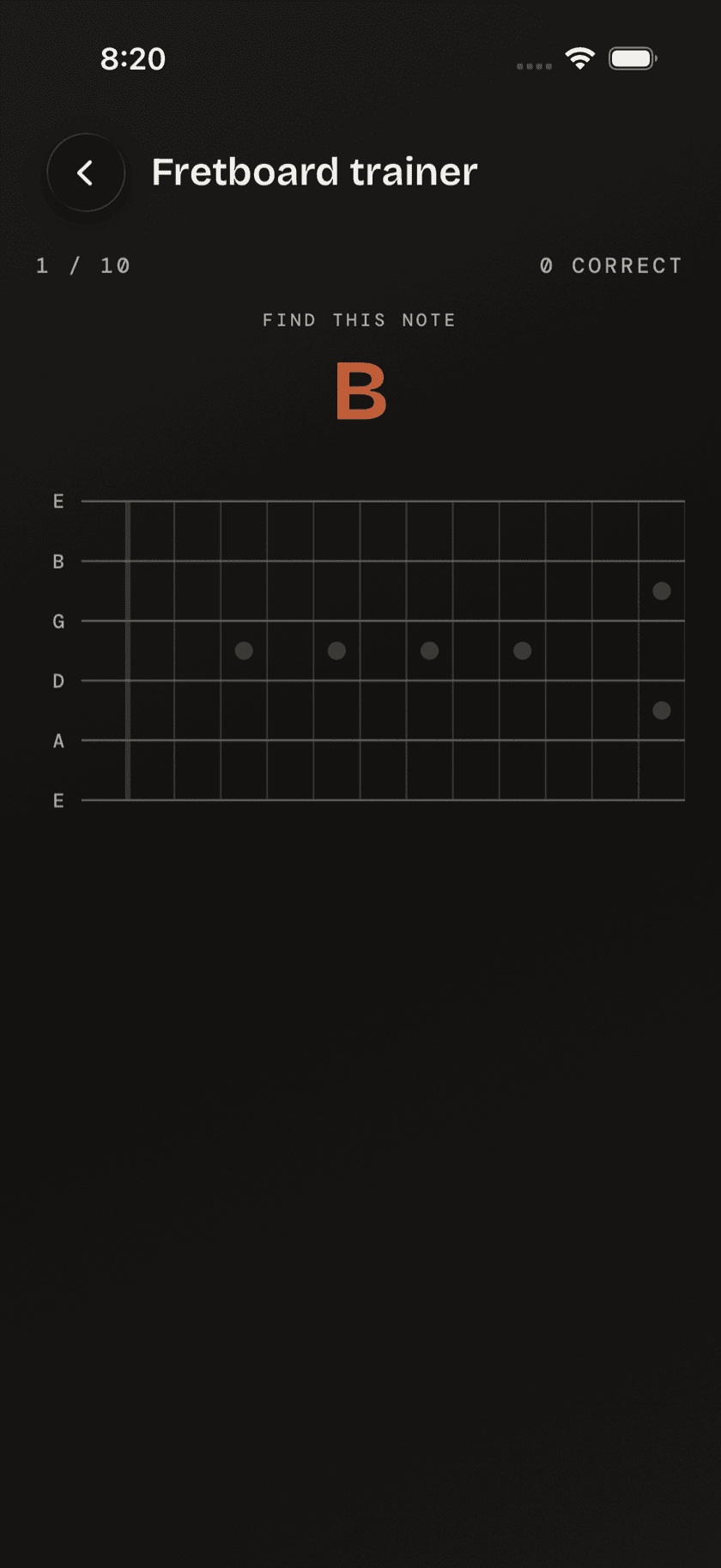
The Trainer is a note-naming quiz, and it runs in two directions. Find this note names a note and asks you to tap where it lives on the neck. Name this note flips it — a fret lights up, and you pick the correct letter from a list. Both test the same knowledge from opposite ends, which is the point: knowing that the note at the 5th fret of the low E string is A doesn't automatically mean you can find A when someone just says the word.
You can filter the quiz to one string or all six, and to naturals only or naturals plus sharps and flats — so you can start narrow and widen it out as the easy answers stop being easy.
the two directions aren't just variety for its own sake. Guitarists tend to learn the neck lopsided — strong at reading a fret, weak at locating a name, or the reverse — and drilling only one direction leaves the other blind spot untouched.
Cheat Sheet
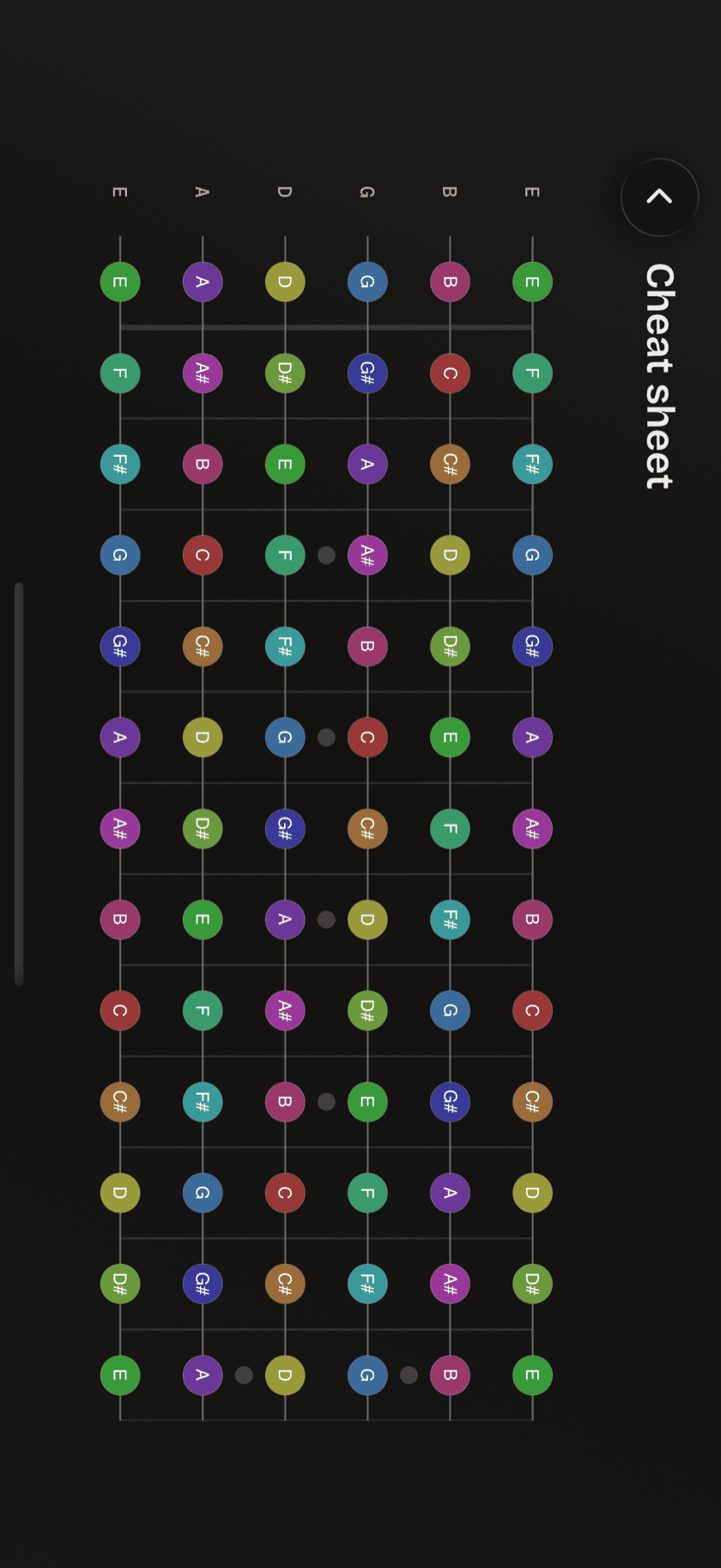
The Cheat Sheet is the opposite of the Trainer: nothing to answer, nothing timed. It's a static map of every note on every string from fret 0 to 12, all labeled at once. Meant to be glanced at while you're figuring something out mid-practice, not studied from top to bottom.
The whole neck doesn't fit on a phone screen in portrait, so the Cheat Sheet rotates to landscape — turn your phone sideways and the full 0–12 stretch appears in one view.
CAGED Explorer
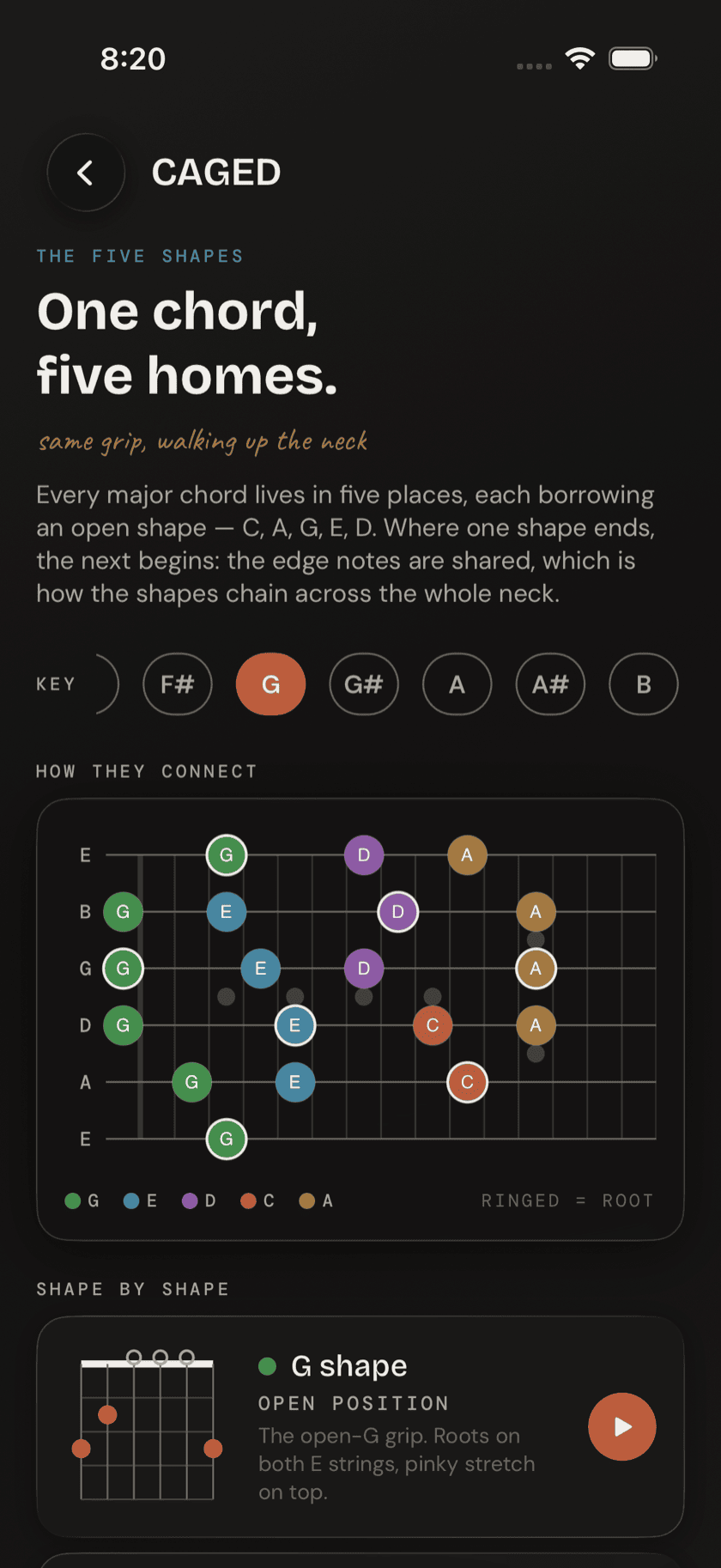
CAGED is the system that explains why five open-chord shapes — C, A, G, E, and D — can be moved up the neck to play any chord in any key, and the Explorer visualizes it directly. Pick a key, and it lays out all five shapes up the neck for that key, in order.
Underneath the individual shapes, a full-neck map shows how their edges line up — where one shape's top note is the next shape's root, and so on, until the five separate shapes read as one continuous pattern running the length of the neck. Each shape also gets its own playable diagram with audio, so you can hear it before you commit it to memory.